
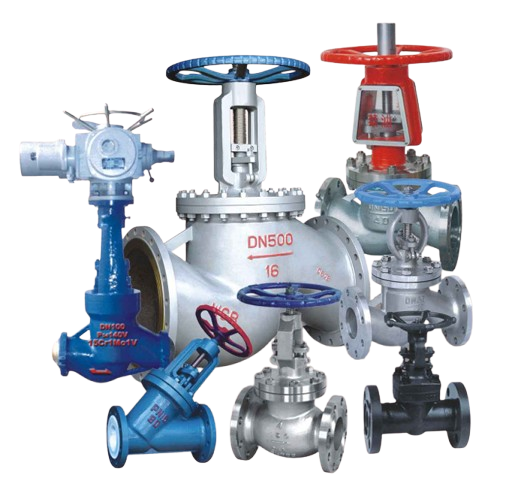
Short Description
A globe valve is a type of valve used to regulate, start, or stop the flow of fluid in a pipeline.
It has a spherical body (globe-shaped) with an internal baffle that forces fluid to change direction, providing good throttling capability. The flow is controlled by a movable plug or disc that presses onto the valve seat, making globe valves ideal for applications requiring frequent operation and precise flow control.
Key Features
- Excellent throttling and flow regulation performance
- Good sealing capability, ensuring minimal leakage
- Suitable for frequent operation (open/close)
- Can be used for both on/off service and flow control
- Available in various designs: T-pattern, Y-pattern, Angle-type
- Reliable in high-pressure and high-temperature applications
- Easy to maintain and replace internal parts
Material Components
- Body : Cast Iron, Ductile Iron, Carbon Steel, Stainless Steel, Alloy Steel
- Bonnet : Carbon Steel, Stainless Steel, Cast Steel
- Disc/Plug : Stainless Steel, Bronze, Alloy Steel, Stellite-faced
- Seat : Stainless Steel, Stellite, or other hard-faced alloys
- Stem : Stainless Steel or Alloy Steel
- Packing : PTFE, Graphite, or other sealing materials
Handwheel / Actuator : Cast Iron, Steel, or with Pneumatic/Electric actuator
Specifications
- Size Range : ½” – 24” (DN15 – DN600)
- Pressure Rating : Class 150 – Class 2500 (PN10 – PN420)
- Temperature Range : -29°C to +550°C (depending on material)
- End Connections : Flanged, Butt Weld, Socket Weld, Threaded
- Design Types : T-Pattern Globe, Y-Pattern Globe, Angle Globe Valve
- Operation : Manual Handwheel, Gearbox, Pneumatic Actuator, Electric Actuator
- Standards :
-
- Design: BS 1873 / API 623 / ASME B16.34
- Testing: API 598 / ISO 5208
- Flange Standard: ASME B16.5 / EN 1092