
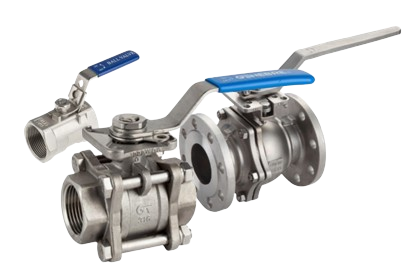
Short Description
A ball valve is a type of valve that uses a spherical disc (the “ball”) to control the flow of fluids (liquids or gases).
The ball has a hole (bore) through its center; when the bore is aligned with the pipeline, flow passes freely, and when rotated 90°, the flow is completely shut off. Ball valves are widely used because they provide tight sealing, reliable performance, and quick operation with just a quarter turn.
Key Features
- Quarter-turn operation (90°) for fast opening and closing
- Excellent sealing performance with minimal leakage
- Suitable for high-pressure and high-temperature applications
- Long service life with minimal maintenance
- Low torque operation and easy to automate
- Available in floating ball or trunnion-mounted design
- Full-bore design available for minimum pressure drop
- Applicable for both on/off and throttling functions
Material Components
- Body : Carbon Steel, Stainless Steel, Forged Steel, Brass
- Ball : Stainless Steel, Chrome-Plated Carbon Steel, Brass
- Seat : PTFE, RPTFE, PEEK, or Metal Seated (for high temperature)
- Stem : Stainless Steel, Alloy Steel
- Seals / Gaskets : PTFE, Graphite, Viton
Handle / Actuator : Carbon Steel, Stainless Steel, or with Pneumatic/Electric actuator
Specifications
- Size Range : ½” – 48” (DN15 – DN1200)
- Pressure Rating : Class 150 – Class 2500 (PN10 – PN420)
- Temperature Range : -46°C to +450°C (depending on material and seat design)
- End Connections : Threaded (NPT/BSP), Socket Weld, Butt Weld, Flanged
- Design Types : Floating Ball, Trunnion Mounted, Full Bore, Reduced Bore
- Operation : Manual Lever, Gearbox, Pneumatic Actuator, Electric Actuator
- Standards :
-
- Design: API 6D / ISO 17292
- Testing: API 598 / ISO 5208
- Fire Safe: API 607 / ISO 10497
- Flange Standard: ASME B16.5 / EN 1092