
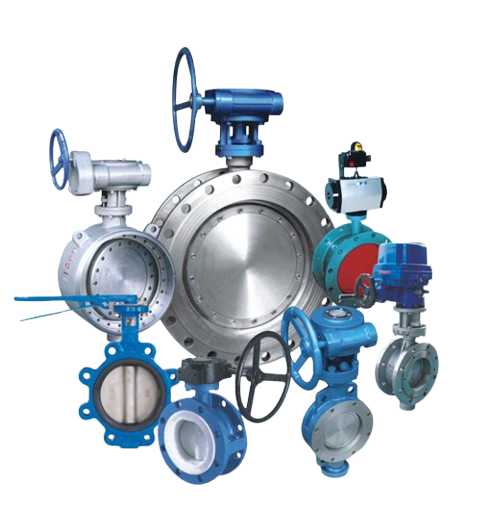
Short Description
A butterfly valve is a type of valve used to regulate, open, or close the flow of fluids (liquids or gases) in a pipeline.
It consists of a thin disc (disk) shaped like a butterfly’s wing that rotates on its axis. When the disc is turned parallel to the flow direction, the fluid can pass freely. Conversely, when the disc is turned perpendicular, the flow is shut off.
Key Features
- Simple and compact design with lightweight construction
- Quarter-turn operation (90°) for quick opening and closing
- Low pressure drop and energy-efficient flow control
- Suitable for both on/off and throttling services
- Wide range of sizes available, especially for large-diameter pipelines
- Compatible with manual, pneumatic, or electric actuators
- Cost-effective compared to other valve types (e.g., gate or ball valve)
- Easy installation and maintenance
Material Components
- Body : Cast Iron, Ductile Iron, Carbon Steel, Stainless Steel
- Disc : Stainless Steel, Ductile Iron, Aluminum Bronze, or Nickel-Plated
- Seat : EPDM, NBR, PTFE, or Viton (depending on media and temperature)
- Stem/Shaft : Stainless Steel or Carbon Steel with anti-corrosion coating
- Bushings & Bearings : Bronze, PTFE, or composite materials
- O-Rings : NBR, EPDM, or Viton
Specifications
- Size Range : DN 50 – DN 2000 (2” – 80”)
- Pressure Rating : PN10, PN16, PN25 (or ANSI Class 150)
- Temperature Range : -20°C to +200°C (depending on seat and disc material)
- Connection Ends : Wafer, Lug, Flanged, or Double Flanged
- Operation : Lever, Gearbox, Pneumatic Actuator, Electric Actuator
- Standards :
-
- Design: API 609 / ISO 5752
- Face-to-Face: EN 558
- Flange Drilling: EN 1092 / ANSI B16.5
- Testing: API 598 / ISO 5208