
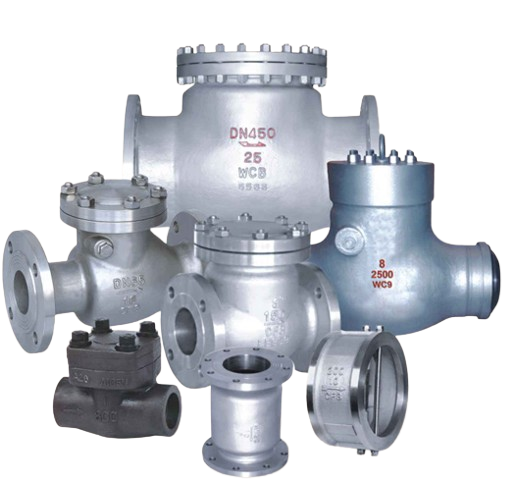
Short Description
A check valve is a type of valve that allows fluid (liquid or gas) to flow in only one direction and automatically prevents backflow.
It works without manual operation—using internal components such as a disc, ball, or swing mechanism that closes automatically when the flow reverses. Check valves are essential for protecting pumps, compressors, and pipelines from reverse flow damage.
key Features
- Prevents reverse flow automatically without external control
- Simple design with reliable operation
- Available in different types: swing check, lift check, ball check, dual plate check, etc.
- Low maintenance and long service life
- Can handle a wide range of pressures and temperatures
- Suitable for horizontal or vertical installations (depending on type)
- Protects equipment like pumps, turbines, and compressors
Material Components
- Body : Cast Iron, Ductile Iron, Carbon Steel, Stainless Steel, Alloy Steel
- Bonnet : Carbon Steel, Stainless Steel, Cast Steel
- Disc/Plug : Stainless Steel, Bronze, Alloy Steel, Stellite-faced
- Seat : Stainless Steel, Stellite, or other hard-faced alloys
- Stem : Stainless Steel or Alloy Steel
- Packing : PTFE, Graphite, or other sealing materials
Handwheel / Actuator : Cast Iron, Steel, or with Pneumatic/Electric actuator
Specifications
- Size Range : ½” – 60” (DN15 – DN1500)
- Pressure Rating : Class 150 – Class 2500 (PN10 – PN420)
- Temperature Range : -29°C to +425°C (depending on material)
- Types :
-
-
- Swing Check Valve
- Lift Check Valve
- Ball Check Valve
- Dual Plate / Wafer Check Valve
- Tilting Disc Check Valve
-
- End Connections : Flanged, Wafer, Lug, Butt Weld, Socket Weld, Threaded
- Standards :
-
- Design: API 6D / API 594 / BS 1868
- Testing: API 598 / ISO 5208
- Flange Standard: ASME B16.5 / EN 1092